_By Judith Matanire_
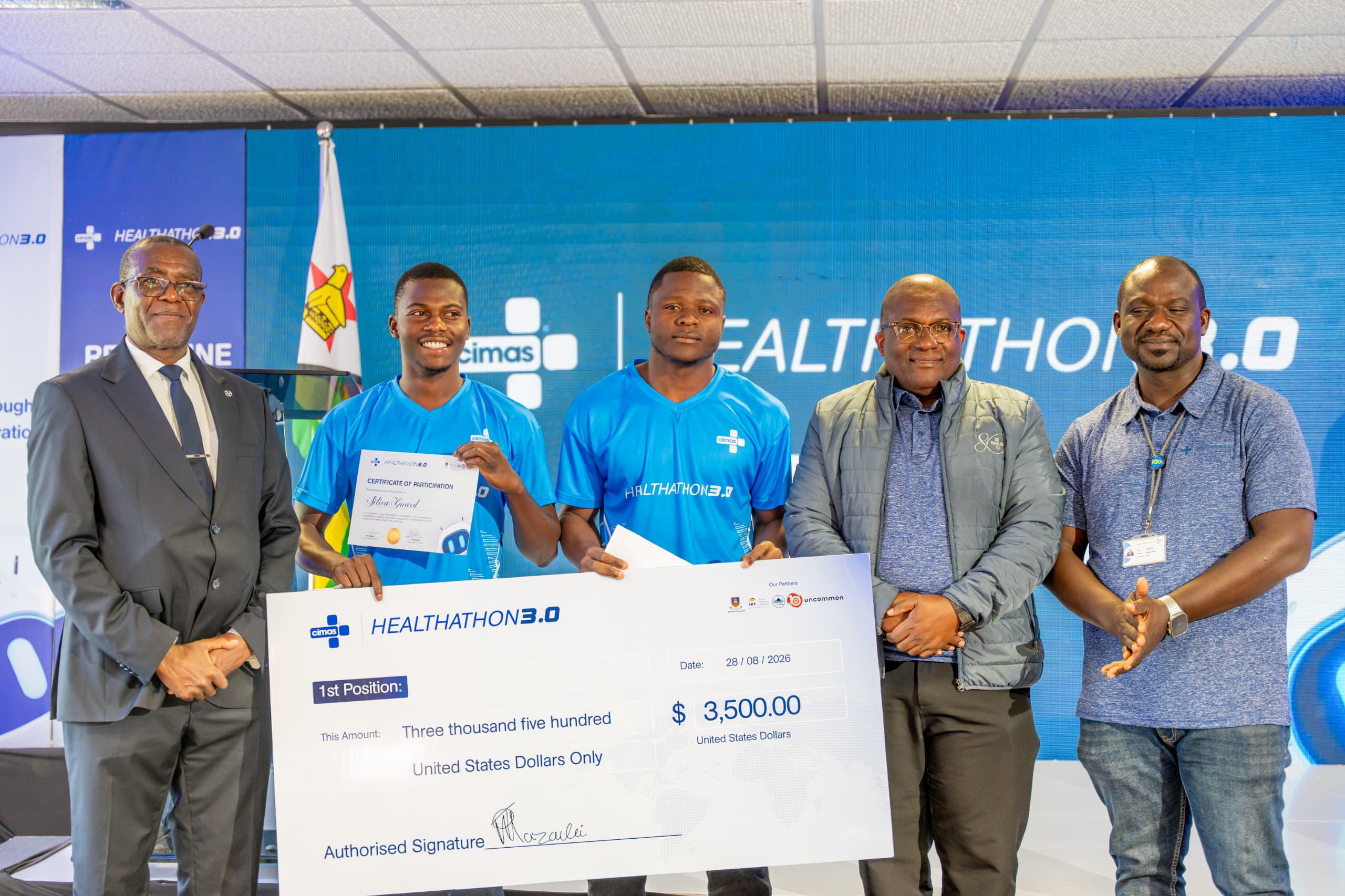
SilicaGuard was crowned the overall winner of the Cimas Healthathon 3.0 Grand Finale after presenting an accessible digital solution aimed at helping artisanal miners identify their risk of developing silicosis.
The team walked away with US$3 500 after outperforming nine other finalists at the event held at the Cimas Health Group offices in Borrowdale, Harare, on Friday.
Runtime Terrors secured second place and received US$2 000, while Blood Geo Alert finished third and was awarded US$1 500.
Held under the theme “Reimagining Healthcare Through Disruptive Innovation,” the competition brought together students, researchers, start-ups and technology innovators developing solutions to some of Zimbabwe’s most pressing healthcare challenges.
SilicaGuard’s innovation combines USSD technology and artificial intelligence to screen artisanal miners for possible silicosis risk.
The platform allows miners to assess their symptoms, obtain health information, receive referrals and follow up on whether they have visited a health facility.
Because the service can operate on basic mobile phones without requiring internet access, it has the potential to reach miners working in remote and underserved communities.
The 10 finalists were selected from 372 entries submitted from across Zimbabwe, a sharp increase from the six applications received when the initiative was launched several years ago.
Cimas Health Group chief executive officer Mr Vulindlela Ndlovu said the rapid growth in submissions reflected the depth of talent and creativity available in Zimbabwe.

“When we launched the first Cimas Healthathon four or five years ago, we received just six submissions. This year, we received almost 400,” Ndlovu said.
He said the numbers were encouraging, but the true value of the programme would be measured by how many ideas were eventually developed into practical solutions that improved patients’ lives.
“The 372 submissions that we received this year are not the achievement. What we do with the best of those ideas will be the achievement,” he said.
Ndlovu said the innovators represented young Zimbabweans who had identified problems in their communities and chosen to develop solutions instead of simply discussing the challenges.
He added that innovation was not limited to established institutions, universities or major cities.
“Innovation has got no address,” Ndlovu said, noting that promising ideas could emerge from classrooms, hospitals, rural clinics and communities across the country.
Among the finalists were high school scholars from Peterhouse, who competed against tertiary-level teams with an offline cervical cancer screening solution.
Other innovations presented during the finale included an artificial intelligence reproductive health companion for women, an emergency blood donor mobilisation platform, an on-premise healthcare data protection system and a solar-powered backpack designed to transport temperature-sensitive medical supplies.
Team Chengetai Hub presented Tsika, a prototype designed to assess the feet for signs linked to diabetes and support the early detection and monitoring of diabetes-related complications.
Team Viva showcased a mobile solar-powered cold-chain backpack aimed at improving the transportation of vaccines and other temperature-sensitive medical commodities to communities where conventional refrigeration infrastructure is limited.
Team Mambokadzi presented Lily, an artificial intelligence-powered reproductive health companion designed to help women track symptoms, understand health information and prepare for consultations with healthcare professionals.
Blood Geo Alert developed a system intended to mobilise suitable blood donors quickly during emergencies, while Team Lango focused on protecting sensitive healthcare information through an on-premise artificial intelligence data security solution.
Ndlovu urged the finalists to remain focused on the problems they wanted to solve rather than becoming overly attached to their initial products.
“Do not fall in love with your solution. Fall in love with the problem,” he said.
He encouraged innovators to continue listening to patients, healthcare workers and communities as they refined their ideas.
“The most successful innovation is not the one that makes people say, ‘What clever technology.’ It is the one that makes people say, ‘This has made a difference in my life,’” Ndlovu said.
He added that healthcare challenges were too complex for one institution to address alone and called for stronger collaboration between Government, private healthcare organisations, universities, innovators and medical professionals.
In remarks delivered on behalf of Health and Child Care Minister Dr Douglas Mombeshora, the Government said healthcare innovation should be judged by whether it improved patient experiences, reduced costs, assisted healthcare workers and expanded access to underserved populations.
The ministerial address emphasised that innovation was not restricted to digital technology, artificial intelligence or software.
It could also include better healthcare financing models, improved referral systems, locally produced medicines and diagnostics, as well as community health programmes capable of reaching people far from formal health facilities.
The Government challenged innovators to design solutions that served rural communities, low-income households, elderly people and persons with disabilities.
“As we modernise our health system, we must not leave anyone behind. Equity must remain at the centre of every solution,” the address said.
The speech also called for increased private-sector investment in healthcare and stronger cooperation between medical aid societies and healthcare providers.
It noted that disagreements over tariffs, co-payments and delayed payments frequently left patients carrying the financial burden.
Doctors and medical aid societies were urged to rebuild trust, agree on sustainable tariffs and prioritise the interests of patients.
The Government also invited private healthcare funders, providers, academics, actuaries and technology experts to contribute towards the development of Zimbabwe’s proposed National Health Insurance scheme.
The scheme is expected to support the country’s drive towards universal health coverage by protecting citizens from the financial hardship associated with illness.
While congratulating the winning teams, the Government encouraged all finalists to continue developing and testing their ideas beyond the competition.
“The real opportunity begins after today, when a promising idea is validated, incubated, partnered and piloted in the real world,” the ministerial address said.
Cimas said the Healthathon was intended to create a pathway through which promising innovations could move from concepts to incubation, pilot programmes and eventual implementation.
Ndlovu said some ideas developed during previous editions of the Healthathon had already progressed to create real value within the healthcare sector.
He expressed hope that, in the coming years, some of the solutions presented at the 2026 grand finale would be remembered as innovations that began at the Cimas Healthathon before transforming people’s lives.