The helicopter crash. The unanswered questions. The mourning. The presidents. The celebrities. The missing heads. The luxury coffins. The speeches. And finally, the burial.
For more than a week, the death and funeral of businessman and philanthropist Wicknell Chivayo and his wife, Lucy “Lulu” Muteke, dominated Zimbabwean social media, politics, entertainment and public conversation.
It began with a helicopter disappearing into bad weather over Marondera.
It ended with thousands of mourners gathering at Sahwira Glen Forest Memorial Park in Harare as one of Zimbabwe’s most recognisable businessmen and his wife were laid to rest side by side.
But between those two moments was a story filled with grief, controversy, celebrity, political connections, extraordinary displays of wealth and one of the most disturbing revelations of the tragedy: the heads of Wicknell and Lucy were never recovered.
Here is how the story unfolded.
THE HELICOPTER CRASH
On Wednesday, September 30, 2026, Wicknell Chivayo, his wife Lucy Muteke and their companions were travelling back towards Harare after visiting Gandami in Chikomba.
The journey would never be completed.
The Bell 430 helicopter came down at Kudenga Farm in Marondera, about 70–85km east of Harare.
The crash happened at about 5pm, in difficult weather conditions.
According to Wicknell’s security aide, Froster Chisi, the group had travelled in two helicopters. The security team was in the second aircraft.
Chisi later said the pilots had encountered challenging weather on the return journey. Communication with the helicopter carrying Chivayo and the others was eventually lost.
The security helicopter landed in Marondera and waited.
Wicknell’s helicopter never arrived.
The team initially believed it might have landed somewhere else because of the weather. They eventually learnt that it had crashed and that there were no survivors.
THE FIRST ANNOUNCEMENT — AND THE CONFUSION
The first official reports did not name Wicknell Chivayo.
The Zimbabwe Republic Police announced that an aircraft had crashed in the Marondera rural area at around 5pm and said there were six occupants aboard.
Police said more details would follow after responders had attended the scene.
Government spokesperson Nick Mangwana later confirmed that there were no survivors and said the helicopter had been carrying a high-profile businessman, passengers and two pilots.
But there was already confusion.
Different early accounts gave different numbers.
The initial police report said six.
Mangwana’s first account referred to seven people.
Then, after forensic work and investigation, police formally confirmed that five people had actually been aboard the helicopter.
They were:
* Wicknell Munodaani Chivayo
* Lucy Rujeko Muteke
* Senelisiwe Magagula, Lucy’s aide
* Captain Calvin Tafirei Soda, pilot
* Captain Courage Mutavirwa, co-pilot
The police later released the five names officially.
Because the victims had been badly burned, authorities initially struggled to establish their identities.
And that is where the story took an even darker turn.
KUDENGA FARM — THE HORROR AT THE CRASH SITE
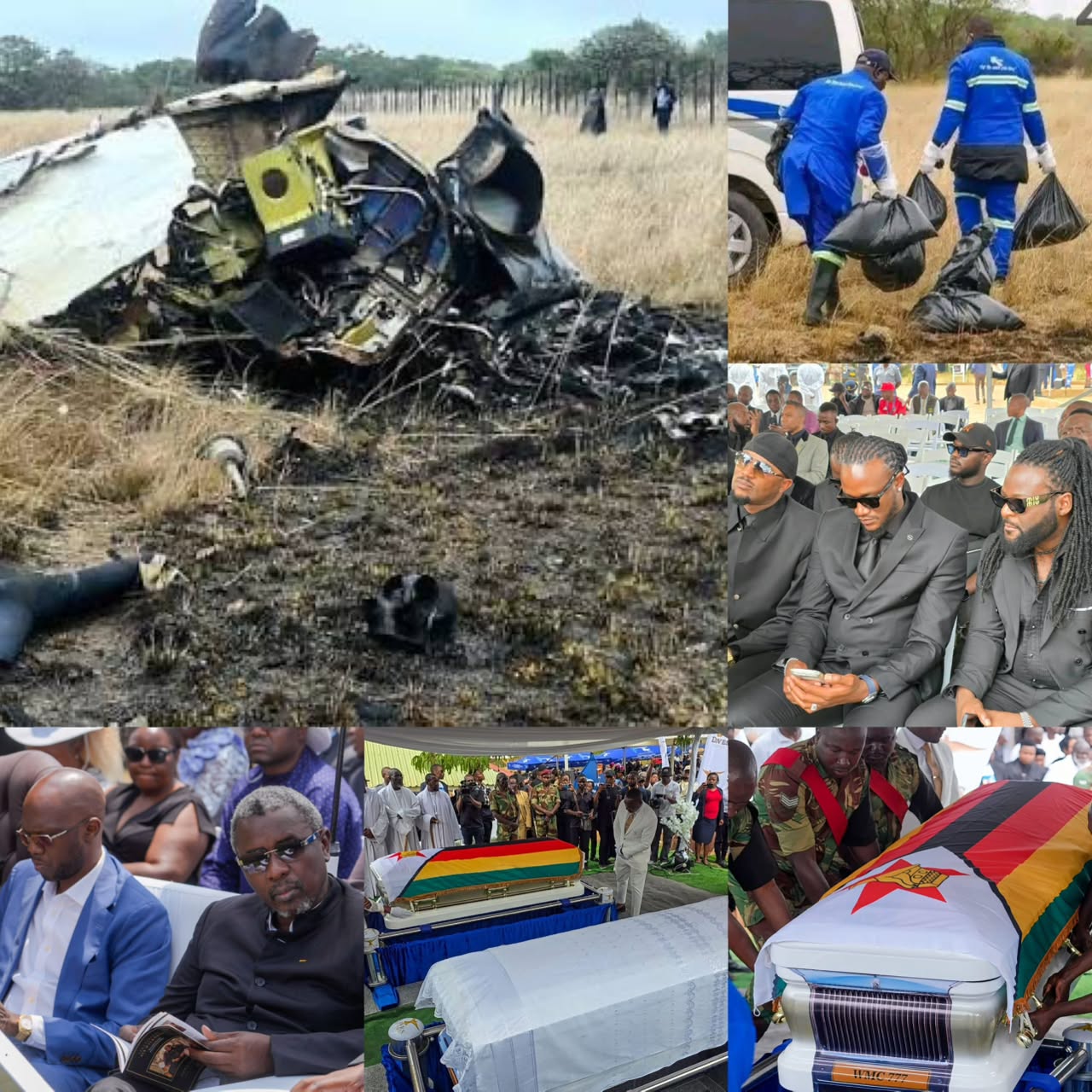
The crash scene at Kudenga Farm was described by people who arrived there as horrific.
The aircraft had crashed into the ground, fuel had spilled and a fire followed.
The Civil Aviation Authority’s preliminary observations indicated that the helicopter hit the ground, spilling fuel which ignited and caused the fire. The exact cause of the crash remains under investigation.
But for the families, the technical cause of the accident was only one part of the nightmare.
The human remains were severely damaged.
Herbert Chivayo, the family’s spokesperson, later described arriving at the scene and seeing human flesh and body parts scattered around the crash site.
The bodies were badly burned and dismembered.
There was no possibility of a conventional viewing of the bodies.
The family would later have to rely on forensic procedures and DNA identification to establish and match the remains.
THE REMAINS — SCATTERED, BURNT AND RECOVERED
The wreckage and remains were processed at the crash site before being moved to Marondera Provincial Hospital for death certification and subsequently to Harare.
ZBC reported that the remains of the five victims were transferred to Harare after processing at the scene.
The images and accounts coming from the scene were deeply disturbing.
Some remains had to be collected from around the wreckage.
The fire had been so intense that the bodies were no longer recognisable.
For the Chivayo and Muteke families, the question was no longer simply who had died?
It was:
How do you bury someone when the remains recovered from the crash are incomplete?
*THE MISSING HEADS
Then came the revelation that shocked the country.
Wicknell Chivayo and Lucy Muteke’s heads had not been recovered.
This was not merely a social-media rumour.
It was confirmed by the Chivayo family.
Family spokesperson Herbert Chivayo said forensic officials had initially considered whether some of the recovered fragments could have been parts of the victims’ heads.
They were not.
After forensic examination, the family was informed that no heads had been recovered.
The family therefore had to prepare to bury Wicknell and Lucy without their heads.
The revelation triggered widespread public discussion and anger.
Questions were raised about the recovery operation, the condition of the crash site and why some remains could not be accounted for.
Fadzayi Mahere publicly questioned why the remains had remained at the crash site overnight and whether better lighting and emergency arrangements could have made a difference.
Those questions became part of the wider controversy surrounding the tragedy.
But the family remained focused on one thing: giving Wicknell and Lucy a dignified farewell.
THE MAN WHO HAD PRESIDENTS IN HIS PHONEBOOK
Wicknell Chivayo was not an ordinary businessman.
Whether people admired him or criticised him, few could ignore his extraordinary public profile.
He regularly posted photographs and videos showing him with some of Africa’s most powerful people.
Among the leaders with whom he had documented relationships were:
Kenya’s President William Ruto.
Tanzania’s President Samia Suluhu Hassan.
South Africa’s President Cyril Ramaphosa.
Eswatini’s King Mswati III.
He had also been photographed with other regional leaders.
His relationship with President Ruto was particularly visible.
Ruto mourned Chivayo publicly, referring to him as his friend and describing his death as a painful loss. (Pulse Kenya)
RUTO’S CONDOLENCES
Kenyan President William Ruto was among the first African leaders to publicly mourn Chivayo.
The Kenyan president spoke of Chivayo’s friendship, energy and belief in Africa.
It was a remarkable reflection of just how far Chivayo’s personal network extended beyond Zimbabwe.
A Zimbabwean businessman who had built a huge social-media presence around his wealth and relationships had become known in political circles across the region.
RAMAPHOSA ALSO SENDS CONDOLENCES
South African President Cyril Ramaphosa also sent condolences to President Emmerson Mnangagwa following the deaths.
The message was significant because Chivayo’s relationship with Ramaphosa had previously attracted controversy.
Earlier in 2026, Chivayo had been seen travelling with President Mnangagwa and Ramaphosa in Zimbabwe.
South Africa’s presidency had previously sought to distance Ramaphosa from Chivayo, saying the president had not known in advance that Chivayo would be present.
After Chivayo’s death, however, Ramaphosa joined Ruto and Samia in sending condolences.
THEN SAMIA SULUHU HASSAN FLEW TO ZIMBABWE
Perhaps the most extraordinary diplomatic moment came from Tanzania.
President Samia Suluhu Hassan personally flew to Zimbabwe to mourn Chivayo.
Her visit was kept unusually quiet.
She arrived at Robert Gabriel Mugabe International Airport and was driven to the Chivayo family home in Gletwyn.
Journalists and mourners were reportedly instructed not to photograph or film the visit.
Nevertheless, images of her motorcade later emerged, as did images of her Tanzanian presidential aircraft.
She spent less than three hours in Zimbabwe before departing.
The Tanzanian president had been expected to attend the opening of the Inter-Parliamentary Union Assembly in Arusha, but instead sent a pre-recorded message.
It was one of the clearest indications of the unusual relationships Chivayo had cultivated during his lifetime.
. *THE MOURNING AT GLENTWYN
As news of the deaths spread, the Chivayo family home became a magnet for mourners.
Politicians arrived.
Business leaders arrived.
Church leaders arrived.
Musicians arrived.
Sports personalities arrived.
Influencers and socialites arrived.
And ordinary people who had benefited from Chivayo’s generosity came to tell their stories.
The funeral increasingly became a gathering of the different worlds Chivayo had moved through during his lifetime.
*THE CELEBRITIES AND INFLUENCERS
The entertainment industry was heavily represented.
Among those reported at the family home were:
Jah Prayzah, Sandra Ndebele, Sulumani Chimbetu, Peter Moyo, Charles and Olivia Charamba, Vabati vaJehovha, Pokello Nare, Lorraine Guyo, Patson “Chipaz” Chimbodza and members of the Dziva Rembira group.
Sports personalities also came to pay their respects, including Dumisani Mpofu, Brenna Msiska, Wellington Mupandare and legendary commentator Charles “CNN” Mabika, alongside Scottland FC players and officials.
The list reflected the extraordinary breadth of Chivayo’s relationships.
He had given money and cars to musicians.
He had supported sports.
He had donated to churches.
He had helped individuals who became famous through social media.
Many of those people now returned to mourn him.
JAH PRAYZAH’S WEDDING BECOMES PART OF THE STORY
One of the most emotional side stories involved musician Jah Prayzah.
His wedding had been scheduled for the same period.
Following Chivayo’s death, the wedding was postponed.
Wedding-related services were subsequently redirected towards the funeral arrangements.
A celebration that was supposed to mark one man’s marriage instead became part of another man’s farewell.
*THE MOURNING — AND THE CELEBRATION
There was grief, but there was also celebration.
At the family home, mourners sang.
Church members prayed.
People shared memories.
Beneficiaries of Chivayo’s philanthropy spoke about how he had helped them.
Some mourners defended him against criticism that had followed his death, arguing that whatever controversies surrounded him, his generosity had changed people’s lives.
It was a funeral that reflected Chivayo himself:
large, public, emotional and impossible to ignore.
*THE CONTROVERSY DID NOT STOP
Chivayo’s death did not erase the controversies surrounding his life.
His wealth, government contracts, political relationships and public displays of luxury had attracted admiration from some Zimbabweans and intense criticism from others.
His business dealings had previously faced scrutiny, including controversy around government tenders.
He denied wrongdoing in relation to allegations against him.
Even during the mourning period, social media remained divided between those celebrating his generosity and those questioning his wealth and political connections.
The funeral therefore became more than a farewell.
It became a public debate about wealth, influence, philanthropy, politics and privilege in Zimbabwe.
*THE COFFINS
Then came the images that dominated social media.
Two distinctive white coffins.
Wicknell’s coffin featured a Rolls-Royce-style front grille and carried the registration WMC 777.
Lucy Muteke’s coffin featured a Mercedes-Benz-inspired front.
Wicknell’s coffin was later draped in the Zimbabwean flag after the Government conferred Provincial Hero status on him. (Herald Online)
Even in death, the couple’s final journey carried the visual language of the lifestyle with which Wicknell had become associated.
*THE PROVINCIAL HERO STATUS
The Government declared Chivayo a Provincial Hero.
The announcement added an official state dimension to a funeral that had already attracted enormous public attention.
His coffin was consequently covered with the national flag.
The honour was described by Government as recognition of his contributions to communities, churches and other causes. (The Star)
The decision itself also became part of public debate, particularly because of Chivayo’s controversial political and business profile.
*THE FUNERAL PROCESSION
On Wednesday, October 7, the remains left Doves Funeral Services.
What followed was one of the largest funeral processions seen in Harare in recent years.
Thousands gathered in the city centre.
People lined the streets.
Phones came out to record the convoy.
Police closed major roads, including Kwame Nkrumah Avenue and Harare Street, to allow the cortege to pass.
The convoy included luxury Rolls-Royces and Mercedes-Benz vehicles.
Harare’s CBD was effectively brought to a standstill. (Herald Online)
The couple’s remains were then taken to the Gletwyn family home where they lay in state overnight.
THE FINAL NIGHT AT HOME
At Gletwyn, family members, friends, church members and other mourners gathered for the final night before burial.
Vapostori conducted the funeral rites.
Outside, mourners sang and celebrated the lives of the couple.
There were even moments of entertainment, with jesters mimicking aspects of Chivayo’s flamboyant lifestyle.
Money was thrown onto the streets during some of the proceedings.
It was a funeral unlike a conventional quiet farewell.
THE SPEECHES
The speeches brought the story back to the people behind the headlines.
Family members spoke about Wicknell not as the businessman who appeared on social media, but as a brother, husband, son, uncle and friend.
His brother Joachim “G6” Chivayo delivered one of the emotional tributes.
He spoke about Wicknell as his mentor and teacher and recalled the role his brother played in his life.
His tribute eventually turned into song.
Other family members also broke down as they remembered the couple.
The speeches provided some of the most personal moments of a funeral that had otherwise been dominated by public spectacle.
THE KING OF ESWATINI SENDS A DELEGATION
King Mswati III of Eswatini did not personally attend, but he sent a seven-member delegation to Zimbabwe.
The delegation included government representatives, pastors and businesspeople who had worked with Chivayo.
The message from the King and Queen Mother described Chivayo’s death as a major loss and said Africa had lost someone who still had much to contribute.
The delegation described him as a bright star who had the potential to make a significant contribution to the region and continent. (Herald Online)
OCTOBER 8 — THE FINAL FAREWELL
Then came Thursday.
October 8, 2026.
The final day.
Wicknell Chivayo and Lucy Muteke were taken to Sahwira Glen Forest Memorial Park in Harare, where they were buried side by side.
The burial brought together Government officials, politicians, business leaders, church leaders, musicians, sports personalities, celebrities, friends and ordinary Zimbabweans.
Among those reported at the burial were Kudakwashe Tagwirei, Scott Sakupwanya, Tatenda Mavetera, Ziyambi Ziyambi, Prophet Uebert Angel, Jah Prayzah, Mudiwa Hood and the Eswatini delegation.
THE FINAL GOODBYE
At the graveside, prayers and songs filled the air.
The couple were laid to rest together.
Wicknell’s coffin, bearing the WMC 777 identity and Zimbabwean flag, disappeared into the ground.
And with it ended one of the most closely followed funerals in Zimbabwean public life.
FROM KUDENGA TO GLEN FOREST
The story began with a helicopter disappearing into bad weather.
Then came the first confusing reports.
A businessman whose name was initially withheld.
Different figures for the number of people aboard.
The identification of five victims.
A horrific crash site.
Scattered and badly burned remains.
Forensic examinations.
DNA identification.
The confirmation that Wicknell and Lucy’s heads had never been recovered.
No body viewing.
Then the mourners.
The celebrities.
The influencers.
The politicians.
President Ruto’s condolences.
President Ramaphosa’s message.
President Samia Suluhu Hassan flying into Zimbabwe to mourn privately.
The Eswatini King’s delegation.
The luxury coffins.
The Provincial Hero status.
The Harare procession that brought the CBD to a standstill.
The speeches.
The music.
The tears.
The controversy.
And finally, the burial.
Wicknell Chivayo and Lucy Muteke are now at rest.
But the questions surrounding the crash — including exactly what caused the helicopter to go down — remain.
Authorities have said investigations are continuing, with the wreckage moved to Charles Prince Airport for further forensic examination, including work by international experts.
For Zimbabwe, however, the Chivayo funeral will be remembered as more than a farewell.
It was a week in which business, politics, celebrity, religion, wealth, philanthropy and tragedy collided in full public view.
From Kudenga Farm to Glen Forest, this was the final journey of Wicknell Chivayo and Lucy Muteke.