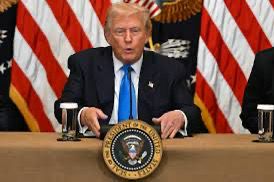
United States President Donald Trump has signed a sweeping executive order reintroducing “reciprocal tariffs” on imports from nearly 70 countries, in a move expected to shake up global trade dynamics ahead of the November elections.
The tariffs — ranging between 10% and 41% — are set to take effect on August 7, with the exception of Canadian imports, which face immediate implementation from August 1.
According to a statement from the White House titled Further Modifying the Reciprocal Tariff Rates, the decision is aimed at countering what Trump called “continued lack of reciprocity in our bilateral trade relationships.”
“I have determined that it is necessary and appropriate to deal with the national emergency declared in Executive Order 14257 by imposing additional ad valorem duties on goods of certain trading partners,” Trump said.
The revised tariffs introduce a baseline 10% rate on US-bound exports from countries like the United Kingdom and Australia, while higher rates were slapped on nations including India (25%), Taiwan (20%), and Switzerland (39%).
Interestingly, the US has also introduced sharp tariff increases on war-torn or economically struggling nations such as Syria (41%), Myanmar (40%), and Iraq (35%), prompting questions from trade analysts over the rationale behind these steep hikes.
Meanwhile, a separate executive order signed on Thursday raised tariffs on certain Canadian goods, with the White House accusing Ottawa of failing to help curb the flow of fentanyl and other illicit drugs into the US.
“These measures reflect both economic and security considerations,” read part of the White House statement, noting that some drug traffickers were exploiting weak enforcement along North America’s borders.
The US Trade Representative’s office confirmed that while countries with whom the US holds a trade surplus will retain the 10% tariff, those with a trade deficit — such as South Africa (30%) and Algeria (30%) — will face higher rates unless new bilateral trade agreements are reached.
The Trump administration previously reached tariff agreements with several key trading partners, including Japan, South Korea, Vietnam, and the European Union, potentially shielding them from future hikes.
However, despite ongoing negotiations, some allies such as India and Taiwan remain subject to steep rates, raising concerns about the consistency and strategic impact of Washington’s trade policies.
As the global economy grapples with inflation, supply chain disruptions, and geopolitical tensions, the reintroduction of US tariffs could further complicate market access for exporters — particularly those in emerging markets.
The White House said the delay in implementation for most tariffs was designed to give US Customs and Border Protection time to adjust operationally to the new framework.